



Fintech Software Development Partner: 12 Questions to Ask
| TLDR (Quick-Answer Box) Vetting a fintech software development partner comes down to proof, not pitch, tested across four stages: Stage 1: Do their compliance claims survive a follow-up question? Stage 2: Can they prove delivery experience instead of just describing it? Stage 3: Who’s actually building your product? Stage 4: Do the final numbers and references hold up before you sign? The 12 questions below walk through all four stages in order. |
Every fintech software development company on your shortlist will open the first sales call with the same pitch: security-first, compliance-ready, PCI DSS certified. Two calls in, they start to sound identical. But what separates a real answer from a sales pitch is proof, and that’s what the 12 questions below are built to test.
The questions are organized around four points where a real evaluation happens: initial screening, technical discovery, team fit, and final sign-off. They work whether you’re evaluating an in-house hire, a nearshore team, or a fully outsourced partner. Before getting into the evaluation, let’s look at what fintech software development actually involves.
What Is Fintech Software Development?
Fintech software development involves building technology for financial products such as banking, payments, lending, investment, and insurance. Because these systems handle money, financial data, and sensitive customer information, security and regulatory requirements need to be built into the infrastructure from the start.
They influence fundamental decisions around data storage, access controls, authentication, transaction processing, audit trails, and system architecture. Treating compliance and security as a final checklist can mean redesigning core parts of the system once the product is already built.
In practice, “fintech software development” spans several distinct categories:
- Digital banking and core banking platforms, the systems behind online and mobile banking experiences.
- Payment processing and payment gateways, moving money between accounts, cards, and institutions, including payment orchestration platforms.
- Lending and credit platforms, covering origination, underwriting, and servicing, such as broker credit workflow automation.
- InsurTech, software built for insurance quoting, claims, and policy management.
- WealthTech and investment platforms, including trading, robo-advisory, and portfolio tools.
- RegTech, software built specifically for compliance and regulatory reporting, such as regulatory reporting automation.
- Embedded finance and Banking-as-a-Service (BaaS), which lets non-fintech companies add financial features to their own products.
- Crypto and blockchain-based platforms, from wallets to smart contract infrastructure.
Regulatory exposure is what sets fintech software development apart from general software development. Rules like PCI DSS, KYC/AML, and GDPR aren’t a feature you add later. They’re a design constraint from the first architecture decision. The build itself follows the same lifecycle as most software products, from discovery through MVP to launch and iteration, but compliance and security review gate nearly every stage along the way.
This applies whether you’re a fintech company building your core product or a non-fintech company adding embedded finance features to an existing one. The vetting logic below works for both, because both face the same underlying questions once development starts.
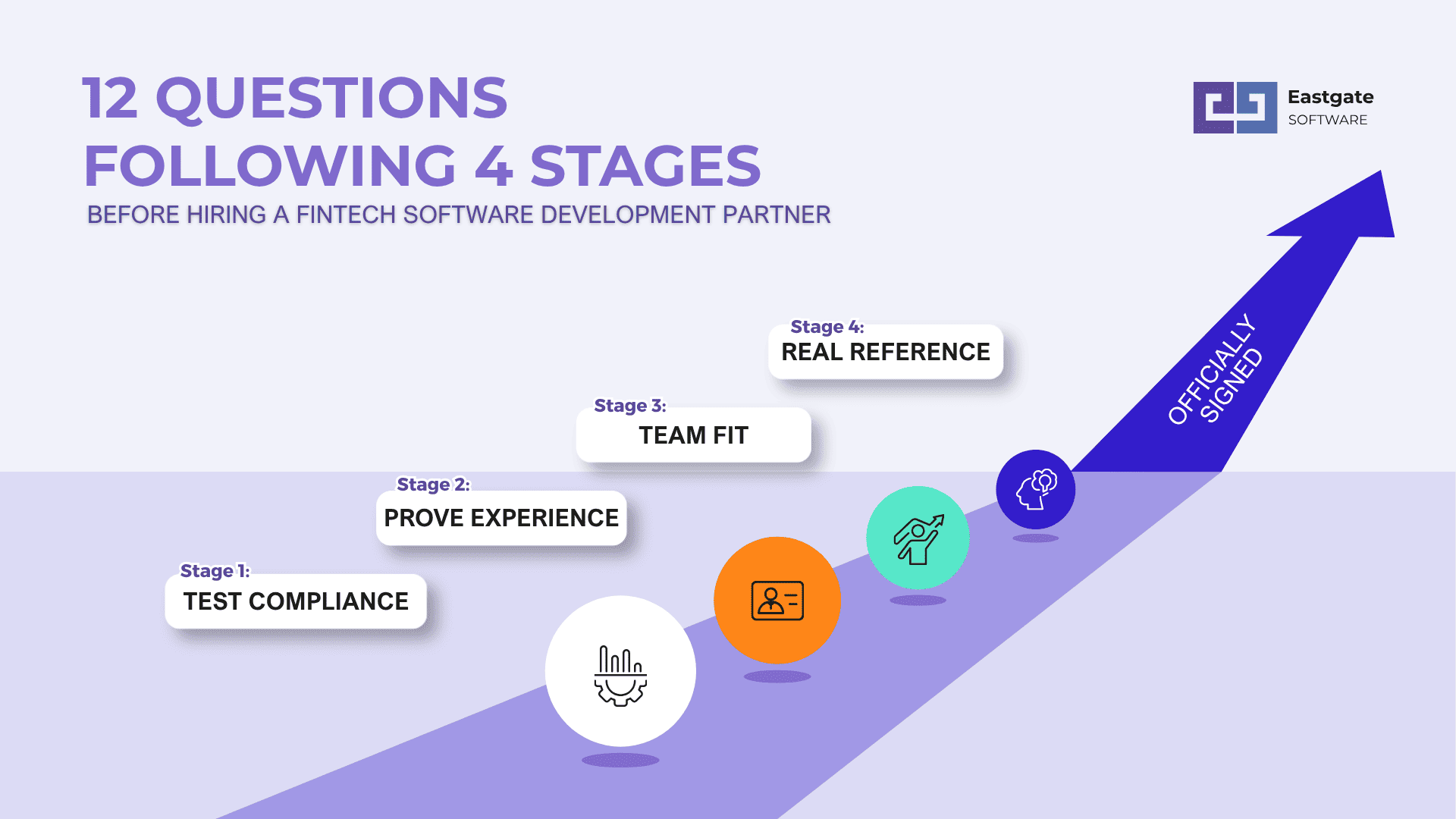
Stage 1: Test Their Compliance Claims Before You Shortlist Them
Before you invest real time in a fintech software development company, screen out the ones whose compliance claims don’t survive a follow-up question. Compliance is the single most common claim across fintech vendor sites, precisely because it’s the easiest one to make and the hardest for a buyer to verify from a homepage.
Ask for a compliance audit they’ve actually passed
Ask which specific audit they have completed, who conducted it, and when. A vendor with real compliance depth will name the audit type, such as a SOC 2 Type II report or a specific PCI DSS assessment level, give you a rough date, and offer to share a redacted summary or attestation letter. A vendor without it will reach for vague reassurance, like “we follow best practices.” That gap is the answer.
Watch for a specific substitution too. Some vendors point to a partner’s certification instead of their own, for example, citing their cloud provider’s SOC 2 report as if it covers their own application layer. It doesn’t, and a team that conflates the two hasn’t actually been through an audit itself.
Ask which specific regulations they’ve built for
“Compliance” covers a wide range of regimes, and each region carries its own set of rules. A vendor who can’t name which ones they’ve actually shipped against is speaking in generalities.
Push past the capability list. Ask them to map a specific regulation to a specific past project. Then ask what changes if your target market shifts, for example from the EU to the US or to Southeast Asia. A team with real cross-jurisdiction experience will have a ready answer. A team without it will start improvising.
For example, A team that built lending software under US rules like Regulation B and the Fair Credit Reporting Act isn’t automatically ready to navigate the EU’s Consumer Credit Directive. Both technically fall under “lending compliance,” but the rules underneath differ.
Ask a live security question and watch who answers it
During a sales call with both an account manager and an engineer present, ask something specific, such as how they handle key rotation for stored payment data. The answer can tell you whether the technical expertise goes beyond the sales pitch.
Pay attention to who answers and how specific the answer is. If the account manager responds instead of the engineer, or the answer stops at “we use encryption,” dig deeper. Encryption is an outcome, not an explanation of how the system works. Ask how often keys rotate, who can trigger a rotation, and what happens to data encrypted with a retired key. A team that has built this kind of system should be able to explain those details clearly.
You don’t need to be a security expert to run this test. One specific question, directed to the person who would actually build the system, can reveal a lot about the team’s technical depth.
Stage 2: Make Them Prove Delivery Experience, Not Describe It
Once a vendor survives Stage 1’s compliance screen, this is the technical diligence call. At this stage, you stop taking the pitch deck’s word for it.
Nearly every fintech vendor claims a proven build process and transparent costs. This stage turns those claims into questions that require a specific past project as the answer.
Ask for a project where they caught a compliance or security issue beforehand
A vendor with real experience can describe a specific moment during development when they caught a problem: what was caught, at what stage, and what changed as a result.
A generic answer about “rigorous QA processes” with no specific incident attached is a sign the claim hasn’t been tested in practice. This is different from asking about their QA process in the abstract. You’re asking for one specific memory, and a team with real delivery history usually has one ready without much prompting.
Ask how they handle third-party integration failures
Every fintech build depends on external providers: payment gateways, KYC verification and identity tools, and open-banking aggregators like Plaid, Tink, or TrueLayer. The real question is what happens when one of them goes down.
Monzo’s outage on August 19, 2026, when the bank activated its backup “Stand-in” system after thousands of users couldn’t make payments or transfers, is a useful reference point for how quickly a dependency failure can cascade into a customer-facing problem.
Ask for a named fallback or monitoring strategy, and ideally a real, even minor, past incident they can walk you through.
Ask specifically what your team would see on your end when a provider like this goes down: a clear status alert, a silent failure, or a support ticket you’d have to file yourself just to find out.
Ask for their actual MVP-to-production timeline, and what typically slows it down
Timeline estimates in a sales deck are aspirational. The honest number includes what usually causes delay: compliance review, third-party approval cycles, and scope changes that show up mid-build.
Ask for a delivery range rather than a single estimate. Then ask how many past projects were delivered within that range, how often timelines slipped, and what caused the delays. A vendor who can answer this with specifics has actually shipped enough projects to know their own track record.
If a vendor gives you one confident number with no caveats attached, that’s often a sign they haven’t shipped enough regulated products to know where the real risk sits.
Stage 3: Understand Who’s Actually Building Your Product
Technical credibility is confirmed by Stage 2. Now you’re deciding whether a vendor’s delivery model actually fits how your organization needs to work. Fundamentally, this comes down to an in-house vs. outsourcing software development decision: hire and build the team yourself, outsource the work entirely, or land somewhere in between.
Ask whether the team is in-house, nearshore, or a blended model, and what that means day-to-day
“We have a dedicated team” can describe three very different delivery models, each with different overlap hours, communication cadence, and cost structure. Ask which one, specifically, and what a typical week looks like.
Ask how many time zones the team spans and whether the same engineers will stay on the project throughout. Team continuity matters more than the label “dedicated team” suggests. Find out how often people rotate, how knowledge is documented, and how handoffs are handled if someone moves off the project.
Also ask what happens if a key engineer leaves mid-project. A vendor with a strong bench and a documented handoff process should be able to explain how they would handle the transition without disrupting delivery. Otherwise, you may end up spending time bringing a replacement up to speed on your product, architecture, and decisions already made.
If part of the team is nearshore or offshore, ask how compliance sign-off actually works across time zones
A distributed team can meet compliance requirements just as well as a co-located one, but the sign-off chain needs a specific answer. Who reviews, who approves, and in what time window?
A vendor with a genuine distributed delivery model, whether the engineers sit in Vietnam, Eastern Europe, or elsewhere, should be able to name a specific handoff process and describe where overlap hours exist for compliance-critical reviews. If they can’t, flag it before you commit to an outsourced or nearshore engagement.
Ask for a concrete example: a recent compliance review that required sign-off from someone in a different time zone, and how long it actually took from request to approval. A specific timeline beats a general assurance that “we make it work.”
Ask about their AI and fraud-detection experience beyond the pitch deck
Ask for a specific model or approach they’ve actually shipped, rather than a slide about “AI-powered risk scoring”. If AI is core to your product, ask what happens when the model gets something wrong. A team with real experience will have a story about a false positive or a missed case, and what they changed afterward.
Stage 4: Get Honest Numbers and a Real Reference Before You Sign
Ask to speak with a past client who had a problem, not just a happy one
Start with public review directories like Clutch or Goodfirms, where reviews come from verified clients. Look specifically for a review that mentions something going wrong, a missed deadline, a scope dispute, a security incident, and bring it up directly in the sales conversation or a reference call.
Ask for a reference who can describe how the vendor handled something going wrong. The answer you get, or the refusal, tells you more than any polished case study on their website.
How quickly a vendor says yes matters as much as whether they say it at all. They may need the former client’s permission or have confidentiality limits, but they should still be able to explain their response process and share relevant lessons.
Ask exactly what’s included in the quote, and what triggers a change order
Ask what counts as “in scope” for compliance work specifically, since compliance and security work is consistently the biggest unstated cost driver in fintech builds.
Get this in writing before the engagement starts. Make sure the proposal takes into account all your documents and specs. If you anticipate unexpected changes, raise that early to avoid a series of change orders once development is underway.
Ask what a red flag looks like from their side, and see if they’ll actually answer
A vendor willing to name what makes a bad client engagement, or what would make them walk away from a project, is signaling more confidence than one who only pitches. If every answer in this conversation has been a version of “we’re a great fit for everyone,” treat that as data too.
This question also tells you something about the engagement itself. A vendor who names specific behaviors, like scope changing every week without a change order, is describing a real project they’ve lived through.
Final Thoughts
Every fintech software development company you talk to will describe itself the same way: security-first, compliance-ready, proven process. The 12 questions above don’t ask them to describe anything again. They ask for proof, and the difference between a vendor who has it and one who doesn’t shows up fast.
Bring these questions to the second call. The first call is where vendors get to pitch. The second is where you get to test the pitch. Pay attention to which questions get a specific answer and which get a longer, vaguer one. The vagueness is the data point.
In a category where getting it wrong shows up as regulatory exposure and lost customer trust, the extra twenty minutes these questions take is cheap insurance.
Eastgate Software holds our own fintech and payments work to this same standard: PCI-DSS and ISO 27001 readiness built in from day one, not retrofitted before a client asks. If you put our FinTech & Payments Engineering practice through this checklist, these are the same twelve questions we’d expect to answer.
Frequently Asked Questions
How much does fintech software development cost?
Costs typically range from $25,000–$150,000 for an MVP, $150,000-$500,000 for a mid-complexity platform, and $500,000 to $1 million or more for an enterprise-scale system.
How do I find the right fintech software development company?
Ask for proof instead of taking marketing claims at face value: a named compliance audit, a specific past incident they caught, and a reference who can describe a time something went wrong.
Should I build fintech software in-house or outsource it?
It depends on the compliance and security expertise you already have on staff, your timeline pressure, and whether a blended model, combining in-house oversight with a nearshore or outsourced team, closes the gap without a full internal hire.
What’s a red flag when vetting a fintech software development partner?
Watch for vendors who only offer happy-client references, can't name a specific regulation they've built for, or route security questions through sales instead of engineering.
エンジニア
フルスタック、AI/ML、ドメイン専門家の体制
顧客継続率
グローバル企業との複数年にわたるパートナーシップ
平均立ち上がり
フルチームを投入し、生産性を最短で確立